
Antigen Design Services
Successful antibody discovery begins with effective antigen design. The quality, format and biological relevance of an antigen directly influence antibody specificity, epitope diversity, affinity and downstream developability. Fusion Antibodies provides custom antigen design services that support therapeutic antibody discovery, antibody engineering and biologics development from target evaluation through to lead optimisation.
Antigen Design Services
Successful antibody discovery begins with effective antigen design. The quality, format and biological relevance of an antigen directly influence antibody specificity, epitope diversity, affinity and downstream developability. Fusion Antibodies provides custom antigen design services that support therapeutic antibody discovery, antibody engineering and biologics development from target evaluation through to lead optimisation.
As a specialist contract research organisation (CRO), we design antigens for monoclonal antibody discovery, recombinant antibody generation and antibody library screening. Every antigen is tailored to the target biology, discovery platform and intended therapeutic application to maximise the likelihood of identifying functional, developable antibodies.
Our antigen design services support hybridoma antibody discovery, rabbit monoclonal discovery, phage display, mammalian display, AI-assisted antibody discovery and recombinant antibody library screening.
What is Antigen Design?
Antigen design is the process of selecting, engineering and producing an antigen that accurately represents the biological target while maximising immune recognition or display-based selection.
Effective antigen design considers target biology, protein structure, epitope accessibility, post-translational modifications and the intended antibody discovery technology. A well-designed antigen improves:
- Antibody specificity
- Epitope diversity
- Functional activity
- Screening efficiency
- Downstream antibody engineering
- Developability assessment
- Lead optimisation
Poor antigen design can result in weak immune responses, non-native epitope recognition and reduced therapeutic relevance.
Why is Antigen Design Important?
Antigen design influences every stage of an antibody discovery programme. Decisions made before immunisation or antibody library screening determine which epitopes are presented and whether resulting antibodies are suitable for downstream development.
Optimised antigen design helps:
- Generate antibodies against biologically relevant epitopes
- Increase the likelihood of identifying functional therapeutic antibodies
- Reduce off-target binding
- Improve antibody library screening
- Support antibody humanisation and affinity maturation
- Improve manufacturability through early developability assessment
Integrating antigen design with antibody discovery and engineering reduces technical risk before laboratory work begins.
Our Antigen Design Workflow
Fusion Antibodies uses a scientific, target-led approach that combines structural biology, bioinformatics and discovery expertise.
Target Assessment
We evaluate target biology, disease relevance, protein localisation, structural complexity and therapeutic mechanism to define the optimal discovery strategy.
Epitope Selection and Antigen Engineering
Using structural analysis and computational modelling, we identify biologically relevant epitopes and engineer constructs that preserve native protein conformation while supporting efficient production and screening.
Depending on programme requirements, antigen formats may include:
- Recombinant proteins
- Extracellular domains
- Truncated proteins
- Synthetic peptides
- Fc-fusion proteins
- Cell-based antigens
- DNA or mRNA immunisation constructs
In Silico Optimisation
Computational analysis supports rational antigen design through:
- Homology modelling
- Protein folding prediction
- Epitope mapping
- Domain architecture analysis
- Surface accessibility
- Transmembrane topology
- Sequence conservation
These analyses improve construct selection and reduce experimental risk.
Expression and Quality Assessment
Recombinant antigens are expressed, purified, and characterised for purity, stability, structural integrity and suitability for immunisation or display-based screening before antibody discovery begins.
Antigen Formats for Different Discovery Strategies
Different targets require different antigen formats to maximise biological relevance and antibody quality.
| Antigen Format | Best Suited For | Key Advantages |
|---|---|---|
| Recombinant proteins | Soluble proteins, extracellular domains | Preserves conformational epitopes for functional monoclonal antibodies |
| Truncated proteins and functional domains | Large or unstable proteins | Focuses immune responses on functional domains |
| Synthetic peptides | Linear epitopes and modified proteins | Rapid, cost-effective generation of sequence-specific antibodies |
| Membrane-bound antigens or Virus-like particles | GPCRs, ion channels, membrane proteins | Maintains native receptor conformation |
| DNA or mRNA immunisation constructs | Difficult-to-express proteins | Enables in vivo antigen expression |
Multiple antigen formats can be combined to maximise epitope diversity and improve therapeutic antibody discovery.
Rational Antigen Design Using In Silico Analysis
Our antigen design workflow combines computational biology with structural analysis to optimise antigen format, stability, and biological relevance.
- Homology modelling and protein folding prediction
- Epitope mapping and domain architecture analysis
- Electrostatic surface and transmembrane topology assessment
This in silico approach improves epitope selection, enhances immunogenicity, reduces off-target reactivity, and increases the likelihood of generating high-affinity, target-specific antibodies.
Proprietary Antigen Engineering
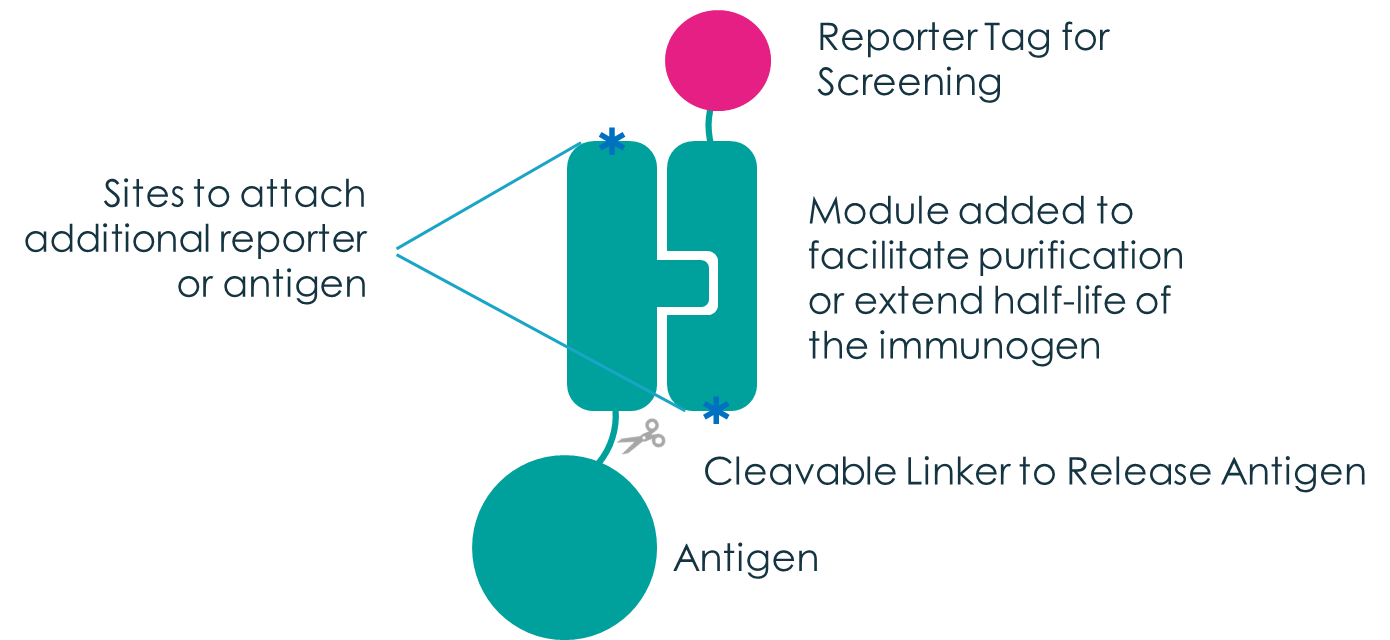
Fusion's proprietary knob-in-hole antigen design technology supports efficient antibody discovery by providing:
- Simplified purification during antigen production
- Improved antigen presentation and extended immunisation half-life
- Flexible screening through interchangeable reporter arms
These engineered antigen formats support both immunisation- and display-based antibody discovery workflows, improving screening efficiency and candidate quality.
Supporting Every Antibody Discovery Platform
Antigen design is closely aligned with the antibody discovery technology used.
Fusion designs antigens for:
- Mouse hybridoma antibody discovery
- Rabbit monoclonal antibody discovery
- Phage display antibody discovery
- Mammalian display (OptiMAL®)
- AI-assisted antibody discovery (AI/ML-ab™)
- Recombinant antibody library screening
Matching antigen design to the discovery platform improves screening efficiency, antibody diversity and downstream developability while supporting antibody characterisation, humanisation and affinity maturation.
Challenging Therapeutic Targets
Many therapeutic targets require specialised antigen engineering because conventional recombinant proteins do not accurately reproduce native biology.
Fusion Antibodies supports programmes targeting:
- GPCRs
- Ion channels
- Membrane receptors
- Multi-pass transmembrane proteins
- Immune checkpoint proteins
- Cancer-associated antigens
- Viral proteins
- Cytokines
- Highly conserved proteins
- Multi-protein complexes
Each antigen is designed to maximise biological relevance while supporting robust antibody discovery.
Frequently Asked Questions
What is antigen design?
Antigen design is the process of creating an optimised antigen that accurately represents the biological target and maximises antibody generation or selection.
Why is antigen design important?
Antigen quality directly affects antibody specificity, epitope diversity, screening success and downstream antibody engineering.
Which antigen format is best?
The optimal format depends on the target biology, antibody discovery platform and intended therapeutic application. Recombinant proteins, peptides, cell-based antigens and engineered constructs each have distinct advantages.
Can antigen design improve therapeutic antibody discovery?
Yes. Rational antigen design increases the likelihood of identifying functional antibodies with favourable developability characteristics, reducing downstream engineering challenges.
Why Partner with Fusion Antibodies?
Fusion Antibodies combines antigen design with integrated antibody discovery and engineering services, enabling programmes to progress efficiently from target biology to lead candidate selection.
Our approach includes:
- Over 20 years of antibody discovery expertise
- Collaborative scientific project management
- Rational antigen engineering informed by target biology
- Integrated workflows from antigen design to antibody characterisation
- Expertise across hybridoma, rabbit monoclonal discovery, phage display, mammalian display and AI-assisted discovery
- Early consideration of developability to support biologics development
Start Your Antigen Design Programme
High-quality antibody discovery starts with high-quality antigen design.
Whether your programme targets membrane proteins, cancer antigens or difficult-to-express proteins, Fusion Antibodies can design antigens that maximise discovery success and support downstream antibody engineering and biologics development.
Contact our scientists to discuss your antigen design requirements.
Tell us what you’re working on.
Share the useful starting details and your enquiry will be sent securely to Fusion’s scientific team.